From Felipe(T/W Team), has not commented yet
From Spencer (Younger Peer),
I like how you showed how even people with a "tough guy image" show sadness for things like suffering from disease. The issue of if Medicare should spend money keeping the dying alive is very controversial and I agree with your insight that if someone wants to die at home, he/she should die in comfort instead of in a hospital attached to machines.
From Amanda (T/W Team),
i like that you talked about the moral issue of in hospital care, and not just the financial issue. and i also enjoyed at the end how you talked about your friends emotions and not just his grandmothers condition. your post shows several different points of view on the same topic i enjoyed that, nice work.
your friend, amanda
From Sarker-Dad (Mentor),
You picked up an interesting and real life-related issue. I commend your strive to explore the agony of a terminally ill patient and relatives in the dying process. Honestly, I didn't know the term 'hospice' and I have learned about two types 'hospice' cares. Also have learned a big budget is also spent on such patients in their last two years of life.
I liked the last para, where you portrait the sufferings of a dying person and feelings and emotional involvement of other concerned people. This is a dilemma that most of us probably have to encounter in a way or other. We have to make tough decisions about our beloved once and young people like you need to start realizing it.
Man is mortal, no one can live in this world forever, however, most of us probably would like to see our close relatives to be in this world as much as possible. We tend to support their treatment as much as possible but the wish of dying person is also of paramount value, if one can respond their consent should be taken before taking the vital decision of giving up. Hope is key in life, we need to uphold it, may be new research or discovery may find new treatment for such dying patients.
I would encourage you to see the 'hope' of miracle treatment of such patients. Drawing up conclusions on a single or few dying patient might not reflect valuable emotional feelings of millions. Budget might not be that big consideration for keeping alive few more days of our beloved one. I would suggest you see both sides of an issue more closely and draw a conclusion at the end basing on credible findings.
All the best,
Sarwar Sarker
Parent
---------------------------------------------------------------
For Amanda (T/W Team),
Amanda,
As always, it was a pleasure to read your blog. It provided many insights as to how limited people can be when thinking that helping other people is an act against nature. When people say doctors are playing God, then what about when a baby that is about to be born starts showing some dangerous condition that might claim his/her life and a doctor saves that baby? So my understanding would be that God never intended that baby to live. Is that doctor playing God? It weird how no one ever asks THAT question and yet it’s also normal for people not to ask that question. The best part of your writing was when you mentioned all the injustice that was happening to a man that was only trying to help others. Bianca did her project on the same topic and I found her blog very insightful as well so you should check it out if you have time. I don’t know if you watched it or not but she also has a link to a very interesting (and heartbreaking) video on her blog that goes through a man’s journey as he travels to Switzerland for his assisted suicide.
For Felipe (T/W Team),
Felipe,
I think your blog was very neatly crafted. I am referring to how you started with the scientific research and moved to the extremely emotional and personal story about your grandfather. This may sound crude but I actually enjoyed the whole fiasco that was brought on by the untimely deaths of your grandfather’s immediate family’s death. I liked how you touched on the key aspects of what could lead to someone being traumatized and how we can see similar psychological symptoms in almost everyone. Makes us realize that no matter how different we try to be, we are still all very similar and that is normal which means that it is weird…
Wednesday, January 19, 2011
Monday, January 17, 2011
HW 30
One of the most riveting topics in life is the process of dying. For my project, I decided to focus on the death of terminally ill patients and how they and their loved ones process losing a loved one. The dominant social practice concerning the passing away of someone who has no chance of survival is to get admitted to a hospital and spend the rest of their life connected to machines that will prolong their life by a few months. This type of care is called Hospice. Most hospice care focuses on physical, emotional, and spiritual symptoms a terminally ill patient goes through. There are two kinds of hospice care that I explore in this project; in-hospital hospice or at-home-hospice.
In class reading materials such as the article called, “The Way We Die Now” helped me understand how simple the decision between in-hospital hospice and at-home-hospice really is. “…about $67 billion – nearly a third of the money spent by Medicare – goes to patients in the last two years of life.” Instead of preventing illnesses, the government/insurance companies choose to spend money to ease the suffering from those illnesses. The money that is being spent on helping terminally ill patients die could be spent to try and stop from those patients from ever being fatal. In-hospital hospice is not just a financial problem, it also affects people’s morals. “… both she and my father let go that part of their lives and they could not control and instead began to focus on what they could control: the joys and blessings of their marriage.” The elderly couple that is the focus of the article chose to live the remainder of the time they had “surrounded by those they loved.” Some of the insights that I gained from this reading was: If granny wants to die at home so why waste more money by keeping her in the hospital attached to machines?
For the real world exploration part of this project, I decided to interview an acquaintance whose grandmother was diagnosed with breast cancer and after months of chemotherapy, she finally decided to give up “on the useless exposure to radiation and constant visits to the oncologist that ended in nothing but tears.” My acquaintance that actually chose to be anonymous confessed that he was truly broken by his grandmother’s slow death. I don’t know the interviewee very well but I do know that he is someone who likes to have a tough guy image. And for him to confess that he was upset and disturbed by seeing his grandmother suffer through the chemo was somewhat shocking. He did not want to comment on how the rest of his family might have felt at that time because “I(him) don’t want to give you (me) speculative information.” But I think the true reason for his secretive nature was that he was a little ashamed because his father is a doctor as well. He is not an oncologist but he worked in the same hospital and I can imagine how disappointed and ashamed his father must have been seeing his own mother suffer at the place where he is employed to make people better. After his grandmother had decided to accept hospice care (on their own expenses), she had around a month to settle all her affairs and finally die surrounded by people that loved her.
In class reading materials such as the article called, “The Way We Die Now” helped me understand how simple the decision between in-hospital hospice and at-home-hospice really is. “…about $67 billion – nearly a third of the money spent by Medicare – goes to patients in the last two years of life.” Instead of preventing illnesses, the government/insurance companies choose to spend money to ease the suffering from those illnesses. The money that is being spent on helping terminally ill patients die could be spent to try and stop from those patients from ever being fatal. In-hospital hospice is not just a financial problem, it also affects people’s morals. “… both she and my father let go that part of their lives and they could not control and instead began to focus on what they could control: the joys and blessings of their marriage.” The elderly couple that is the focus of the article chose to live the remainder of the time they had “surrounded by those they loved.” Some of the insights that I gained from this reading was: If granny wants to die at home so why waste more money by keeping her in the hospital attached to machines?
For the real world exploration part of this project, I decided to interview an acquaintance whose grandmother was diagnosed with breast cancer and after months of chemotherapy, she finally decided to give up “on the useless exposure to radiation and constant visits to the oncologist that ended in nothing but tears.” My acquaintance that actually chose to be anonymous confessed that he was truly broken by his grandmother’s slow death. I don’t know the interviewee very well but I do know that he is someone who likes to have a tough guy image. And for him to confess that he was upset and disturbed by seeing his grandmother suffer through the chemo was somewhat shocking. He did not want to comment on how the rest of his family might have felt at that time because “I(him) don’t want to give you (me) speculative information.” But I think the true reason for his secretive nature was that he was a little ashamed because his father is a doctor as well. He is not an oncologist but he worked in the same hospital and I can imagine how disappointed and ashamed his father must have been seeing his own mother suffer at the place where he is employed to make people better. After his grandmother had decided to accept hospice care (on their own expenses), she had around a month to settle all her affairs and finally die surrounded by people that loved her.
Monday, January 10, 2011
HW 29
Facing Terminal Illness:
Facing terminal illness can break or unite a family. And sometimes both. When a person is terminally ill, all their loved ones gather to help his/her passing as cheerful as possible. Although that is kind of ironic since death or the process of dying is a very depressing affair. Our guest speaker, Beth Bernett, shared with us her experience of how her husband was diagnosed with cancer and how her family had to unite so they could all be strong. They tried their best so her husband, Erik, would never think about death. In My Brother, the author goes through the grueling process of watching her brother slowly die after he was tested HIV positive. At one point in the book the author, Jamaica, says to be tired “seeing him like this. I wish he would just die already.” Seeing her brother terminally ill made her feel sorry for him and wished he would just die instead of suffer day by day. This shows how she changed due to the fact that she was faced with the possibility that her brother might be dying because I am sure that she would never have wished that someone in her family would just die.
Being Sick:
I have personally never been sick. Or at least never been sick enough to complain about it. However, I used to have the occasional headache but that was primarily due to me getting around 3-4 hours of sleep every night. I compensated for my sleep deprivation by drinking a lot of caffeine. This started when I was 13 years old so even a moderate amount of caffeine (moderate to adults) was probably very unhealthy for me. Like with every other drug, as you use it more and more often, you also need to increase the quantity so it will give you the same kick that you would have gotten when you first started using it. My case was no different from all other drug addicts. As my parents started to notice my increase in caffeine consumption, they started to “cut me off”. After suffering from withdrawal for a few days, I had decided that I must find alternatives to my caffeine addiction so I decided to sleep more and devote less time to my computer screen. When people are sick, they do things that they would not otherwise think of doing. Same goes for people who are terminally sick. I think that is why some people consider cancer a gift. They realize what they could have done if they weren’t sick. Same way I realized if I wasn’t addicted to caffeine and computers, I would be much more successful in school and in other social practices.
Facing terminal illness can break or unite a family. And sometimes both. When a person is terminally ill, all their loved ones gather to help his/her passing as cheerful as possible. Although that is kind of ironic since death or the process of dying is a very depressing affair. Our guest speaker, Beth Bernett, shared with us her experience of how her husband was diagnosed with cancer and how her family had to unite so they could all be strong. They tried their best so her husband, Erik, would never think about death. In My Brother, the author goes through the grueling process of watching her brother slowly die after he was tested HIV positive. At one point in the book the author, Jamaica, says to be tired “seeing him like this. I wish he would just die already.” Seeing her brother terminally ill made her feel sorry for him and wished he would just die instead of suffer day by day. This shows how she changed due to the fact that she was faced with the possibility that her brother might be dying because I am sure that she would never have wished that someone in her family would just die.
Being Sick:
I have personally never been sick. Or at least never been sick enough to complain about it. However, I used to have the occasional headache but that was primarily due to me getting around 3-4 hours of sleep every night. I compensated for my sleep deprivation by drinking a lot of caffeine. This started when I was 13 years old so even a moderate amount of caffeine (moderate to adults) was probably very unhealthy for me. Like with every other drug, as you use it more and more often, you also need to increase the quantity so it will give you the same kick that you would have gotten when you first started using it. My case was no different from all other drug addicts. As my parents started to notice my increase in caffeine consumption, they started to “cut me off”. After suffering from withdrawal for a few days, I had decided that I must find alternatives to my caffeine addiction so I decided to sleep more and devote less time to my computer screen. When people are sick, they do things that they would not otherwise think of doing. Same goes for people who are terminally sick. I think that is why some people consider cancer a gift. They realize what they could have done if they weren’t sick. Same way I realized if I wasn’t addicted to caffeine and computers, I would be much more successful in school and in other social practices.

Tuesday, January 4, 2011
HW 28 - Comments 2
For Amanda: Amanda, I think you exhibited a lot of good thoughts in this post. The fact that you and your family even went to visit a friend of your grandmother is shocking to me. I don't think I even know one of my grandparents' friends. I really liked your description of her house because I felt that it added a sense of hesitancy that you had to leave as soon as possible. Like Andy said, what your grandmother told you about being jealous of you and your brother was quite unique. Since my grandmother if she ever felt that way, would never be that honest with me. I also liked how you ended your blog saying that you would probably not treat her differently even if you saw her again because it shows how we as a society often tend to keep our first impression as the last impression. I also felt that you were treating Roberta as an illness rather than a person. I don't mean this in a bad way. Since I think I know you pretty well personally, I'm just saying you're a open person that doesn't really keep their feelings towards someone bottled up, and I like that.
Monday, January 3, 2011
Trigger Application for Macs and PCs
Step 1: Click Here To download a freeware called TimeLeft
Step 2:

Step 3:

Step 4:

Step 5:

Step 6:

Step 7:

Step 8:

Step 9:

Step 10:
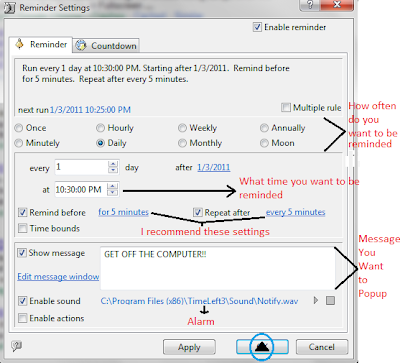
And You Are Done!
Macintosh Users:
Step 1. Click Here to download an application for Mac OS X 10.2 or later
Many of you will probably have it already. It is one of Apple's (flawed) default apps.
If you do have it. Skip to Step 3
Step 2. Install the application. It is fairly simple so I will not go over it. Just make sure you are on the administrative account of the computer you are using.
Step 3. You should see this window if you have successfully installed the application:

Step 4: Go to the time frame you want to set your reminder and click on New Event. For example, I use 10:30 PM

Step 5: Right Click on the time section and click Get Info

Step 6: Set The Alarm and Message As You Please... Make sure you set the repeat time to Every Day If You Want To Make Going To Bed A Daily Habit
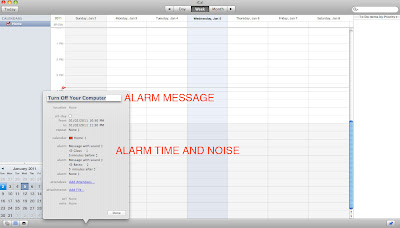
And You Are Done!
Step 2:

Step 3:

Step 4:

Step 5:

Step 6:

Step 7:

Step 8:

Step 9:

Step 10:

And You Are Done!
Macintosh Users:
Step 1. Click Here to download an application for Mac OS X 10.2 or later
Many of you will probably have it already. It is one of Apple's (flawed) default apps.
If you do have it. Skip to Step 3
Step 2. Install the application. It is fairly simple so I will not go over it. Just make sure you are on the administrative account of the computer you are using.
Step 3. You should see this window if you have successfully installed the application:

Step 4: Go to the time frame you want to set your reminder and click on New Event. For example, I use 10:30 PM

Step 5: Right Click on the time section and click Get Info

Step 6: Set The Alarm and Message As You Please... Make sure you set the repeat time to Every Day If You Want To Make Going To Bed A Daily Habit

And You Are Done!
Friday, December 31, 2010
HW 25
I am Michael Moore and anything I say is correct and should not be doubted for even one second. American health care system is messed up. Every middle class and lower citizen in the US seems to think that just because they have health care that means they are fine but it is not until they have a medical emergency, do they realize how utterly screwed they really are. The health care system started to become messed up (if it was ever not messed up) during President Nixon’s time in office. We should just move to Canada or somewhere in Europe where they have universal health care which actually works to benefit the people rather than the elites.
Two senior citizens who always paid their taxes and were “model citizens” their whole life had to sell their home and move in with their children because they could not afford the cost of the husband’s cardio treatment and the wife’s cancer treatment. Another example was that one woman had health insurance and when she had an emergency medical problem, her insurance company bailed out because she had a harmless yeast infection a few years back that she thought wasn’t important enough to mention in her insurance “signup sheet”.
People think that if you pay your taxes and follow the rules like you should, your government will take care of you. Your government will not let you get screwed over by a money hungry medical system.
Insurance companies that want to make a profit (all of them) do not want to bear the cost of an expensive treatment so they just cut the patient off. I do not even need to explain how ridiculous and unfair that is.
The drug act of 2003 which was created to help senior citizens in the US more extensively than standard health care would. What they did not mention while the elitist of that time passed the law, was that the medicine companies would be free to name their price for all the medicine that they provided. If the demand for one medicine increased, the price for it would skyrocket. Price gauging and preying on the needy should be made illegal, but why would it be? Why would the US government help the people that put them in power instead of making more money? Sources: https://www.cms.gov/mmaupdate/
I thought Sicko was an incredibly insightful movie. It was silly and a bit too obvious at some parts but at others, it provided some crucial information that most Americans are blind to. Everyone in America, yes I said everyone, thinks that if you do not have health insurance, you are in big trouble. They are right but after watching Sicko, I realized that having health insurance or being able to afford it isn’t that much better.
Two senior citizens who always paid their taxes and were “model citizens” their whole life had to sell their home and move in with their children because they could not afford the cost of the husband’s cardio treatment and the wife’s cancer treatment. Another example was that one woman had health insurance and when she had an emergency medical problem, her insurance company bailed out because she had a harmless yeast infection a few years back that she thought wasn’t important enough to mention in her insurance “signup sheet”.
People think that if you pay your taxes and follow the rules like you should, your government will take care of you. Your government will not let you get screwed over by a money hungry medical system.
Insurance companies that want to make a profit (all of them) do not want to bear the cost of an expensive treatment so they just cut the patient off. I do not even need to explain how ridiculous and unfair that is.
The drug act of 2003 which was created to help senior citizens in the US more extensively than standard health care would. What they did not mention while the elitist of that time passed the law, was that the medicine companies would be free to name their price for all the medicine that they provided. If the demand for one medicine increased, the price for it would skyrocket. Price gauging and preying on the needy should be made illegal, but why would it be? Why would the US government help the people that put them in power instead of making more money? Sources: https://www.cms.gov/mmaupdate/
I thought Sicko was an incredibly insightful movie. It was silly and a bit too obvious at some parts but at others, it provided some crucial information that most Americans are blind to. Everyone in America, yes I said everyone, thinks that if you do not have health insurance, you are in big trouble. They are right but after watching Sicko, I realized that having health insurance or being able to afford it isn’t that much better.
Saturday, December 11, 2010
HW 22
Kincaid, Jamaica. My Brother. USA Edition. San Val, 1997
In this book I tell the story of my experience before, during, and after my brother, Devon, is admitted in a hospital in Antigua after contracting HIV. In the beginning of the book, I delve into my childhood by exploring my life complications when I used to live in Antigua. Devon was the only one among my mother's four children that was not born in a hospital. The hospital was appalling. It is not just the hospital. It is the general health care in Antigua. I had to bring a special medication made for AIDS patients called AZT from the states since they did not have it in Antigua. The hospital is extremely dirty and mismanaged. Devon was isolated because of his condition, this is the same for every other AIDS patient. One good thing that came from my brother's illness is the fact that I realized I loved him. I guess I always knew that I loved him but it was not until I saw him in the state he was, that I truly openly said it to him. Devon was surprised when I told him I loved him but he was happy in the end and replied kindly. With the help of AZT and other western medication, Devon was starting to feel better and was discharged from the hospital.
"I felt myself being swallowed up in a large vapor of sadness...I became afraid that he would die before I saw him again...It surprised me that I loved him; I could see that was what I was feeling, love for him, and it surprised me because I did not know him at all."
- Kincaid never liked her brother's morals nor his daily practices. She was distant from him her entire life and when she finally faced him again, she realizes that she really does love him.
“I had said to him that nothing good ever could come of his being so ill, but all the same I wanted to thank him for making me realize that I loved him” (21)
- People don't really miss the things they have until they don't have it anymore. Its a good thing Kincaid realized that she loved her brother before it was too late.
“I missed him. I missed seeing him suffer. I missed felling sorry that in the midst of some large thing and hoping he would emerge from it changed for the better. I did not love him.” (57-58)
- As Devon's condition improved, Kincaid grew less and less fond of him. She was starting to take him for granted again.
To be honest, I was not surprised at all when the author said she really did love her brother. Even though Devon has been nothing short of a disappointment to her and their family, he is still her brother which makes her forced by nature to love him. In my opinion, I believe this to be true for every family. No matter how screwed up it is. I personally can't say anything about this matter because thankfully, I never had a family member that I hated. But if there was, I am certain that I would be able to forgive them. No matter what they did.
In this book I tell the story of my experience before, during, and after my brother, Devon, is admitted in a hospital in Antigua after contracting HIV. In the beginning of the book, I delve into my childhood by exploring my life complications when I used to live in Antigua. Devon was the only one among my mother's four children that was not born in a hospital. The hospital was appalling. It is not just the hospital. It is the general health care in Antigua. I had to bring a special medication made for AIDS patients called AZT from the states since they did not have it in Antigua. The hospital is extremely dirty and mismanaged. Devon was isolated because of his condition, this is the same for every other AIDS patient. One good thing that came from my brother's illness is the fact that I realized I loved him. I guess I always knew that I loved him but it was not until I saw him in the state he was, that I truly openly said it to him. Devon was surprised when I told him I loved him but he was happy in the end and replied kindly. With the help of AZT and other western medication, Devon was starting to feel better and was discharged from the hospital.
"I felt myself being swallowed up in a large vapor of sadness...I became afraid that he would die before I saw him again...It surprised me that I loved him; I could see that was what I was feeling, love for him, and it surprised me because I did not know him at all."
- Kincaid never liked her brother's morals nor his daily practices. She was distant from him her entire life and when she finally faced him again, she realizes that she really does love him.
“I had said to him that nothing good ever could come of his being so ill, but all the same I wanted to thank him for making me realize that I loved him” (21)
- People don't really miss the things they have until they don't have it anymore. Its a good thing Kincaid realized that she loved her brother before it was too late.
“I missed him. I missed seeing him suffer. I missed felling sorry that in the midst of some large thing and hoping he would emerge from it changed for the better. I did not love him.” (57-58)
- As Devon's condition improved, Kincaid grew less and less fond of him. She was starting to take him for granted again.
To be honest, I was not surprised at all when the author said she really did love her brother. Even though Devon has been nothing short of a disappointment to her and their family, he is still her brother which makes her forced by nature to love him. In my opinion, I believe this to be true for every family. No matter how screwed up it is. I personally can't say anything about this matter because thankfully, I never had a family member that I hated. But if there was, I am certain that I would be able to forgive them. No matter what they did.
Subscribe to:
Posts (Atom)