Facing Terminal Illness:
Facing terminal illness can break or unite a family. And sometimes both. When a person is terminally ill, all their loved ones gather to help his/her passing as cheerful as possible. Although that is kind of ironic since death or the process of dying is a very depressing affair. Our guest speaker, Beth Bernett, shared with us her experience of how her husband was diagnosed with cancer and how her family had to unite so they could all be strong. They tried their best so her husband, Erik, would never think about death. In My Brother, the author goes through the grueling process of watching her brother slowly die after he was tested HIV positive. At one point in the book the author, Jamaica, says to be tired “seeing him like this. I wish he would just die already.” Seeing her brother terminally ill made her feel sorry for him and wished he would just die instead of suffer day by day. This shows how she changed due to the fact that she was faced with the possibility that her brother might be dying because I am sure that she would never have wished that someone in her family would just die.
Being Sick:
I have personally never been sick. Or at least never been sick enough to complain about it. However, I used to have the occasional headache but that was primarily due to me getting around 3-4 hours of sleep every night. I compensated for my sleep deprivation by drinking a lot of caffeine. This started when I was 13 years old so even a moderate amount of caffeine (moderate to adults) was probably very unhealthy for me. Like with every other drug, as you use it more and more often, you also need to increase the quantity so it will give you the same kick that you would have gotten when you first started using it. My case was no different from all other drug addicts. As my parents started to notice my increase in caffeine consumption, they started to “cut me off”. After suffering from withdrawal for a few days, I had decided that I must find alternatives to my caffeine addiction so I decided to sleep more and devote less time to my computer screen. When people are sick, they do things that they would not otherwise think of doing. Same goes for people who are terminally sick. I think that is why some people consider cancer a gift. They realize what they could have done if they weren’t sick. Same way I realized if I wasn’t addicted to caffeine and computers, I would be much more successful in school and in other social practices.
Monday, January 10, 2011

Tuesday, January 4, 2011
HW 28 - Comments 2
For Amanda: Amanda, I think you exhibited a lot of good thoughts in this post. The fact that you and your family even went to visit a friend of your grandmother is shocking to me. I don't think I even know one of my grandparents' friends. I really liked your description of her house because I felt that it added a sense of hesitancy that you had to leave as soon as possible. Like Andy said, what your grandmother told you about being jealous of you and your brother was quite unique. Since my grandmother if she ever felt that way, would never be that honest with me. I also liked how you ended your blog saying that you would probably not treat her differently even if you saw her again because it shows how we as a society often tend to keep our first impression as the last impression. I also felt that you were treating Roberta as an illness rather than a person. I don't mean this in a bad way. Since I think I know you pretty well personally, I'm just saying you're a open person that doesn't really keep their feelings towards someone bottled up, and I like that.
Monday, January 3, 2011
Trigger Application for Macs and PCs
Step 1: Click Here To download a freeware called TimeLeft
Step 2:

Step 3:

Step 4:

Step 5:

Step 6:

Step 7:

Step 8:
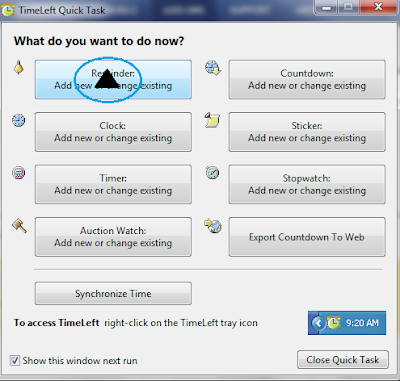
Step 9:

Step 10:
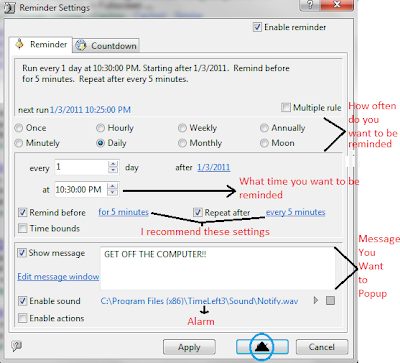
And You Are Done!
Macintosh Users:
Step 1. Click Here to download an application for Mac OS X 10.2 or later
Many of you will probably have it already. It is one of Apple's (flawed) default apps.
If you do have it. Skip to Step 3
Step 2. Install the application. It is fairly simple so I will not go over it. Just make sure you are on the administrative account of the computer you are using.
Step 3. You should see this window if you have successfully installed the application:

Step 4: Go to the time frame you want to set your reminder and click on New Event. For example, I use 10:30 PM

Step 5: Right Click on the time section and click Get Info

Step 6: Set The Alarm and Message As You Please... Make sure you set the repeat time to Every Day If You Want To Make Going To Bed A Daily Habit
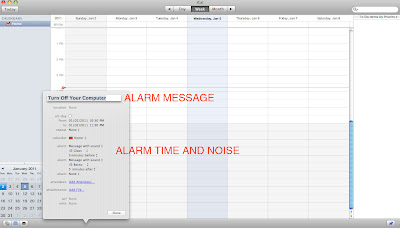
And You Are Done!
Step 2:

Step 3:

Step 4:

Step 5:

Step 6:

Step 7:

Step 8:

Step 9:

Step 10:

And You Are Done!
Macintosh Users:
Step 1. Click Here to download an application for Mac OS X 10.2 or later
Many of you will probably have it already. It is one of Apple's (flawed) default apps.
If you do have it. Skip to Step 3
Step 2. Install the application. It is fairly simple so I will not go over it. Just make sure you are on the administrative account of the computer you are using.
Step 3. You should see this window if you have successfully installed the application:

Step 4: Go to the time frame you want to set your reminder and click on New Event. For example, I use 10:30 PM

Step 5: Right Click on the time section and click Get Info

Step 6: Set The Alarm and Message As You Please... Make sure you set the repeat time to Every Day If You Want To Make Going To Bed A Daily Habit

And You Are Done!
Friday, December 31, 2010
HW 25
I am Michael Moore and anything I say is correct and should not be doubted for even one second. American health care system is messed up. Every middle class and lower citizen in the US seems to think that just because they have health care that means they are fine but it is not until they have a medical emergency, do they realize how utterly screwed they really are. The health care system started to become messed up (if it was ever not messed up) during President Nixon’s time in office. We should just move to Canada or somewhere in Europe where they have universal health care which actually works to benefit the people rather than the elites.
Two senior citizens who always paid their taxes and were “model citizens” their whole life had to sell their home and move in with their children because they could not afford the cost of the husband’s cardio treatment and the wife’s cancer treatment. Another example was that one woman had health insurance and when she had an emergency medical problem, her insurance company bailed out because she had a harmless yeast infection a few years back that she thought wasn’t important enough to mention in her insurance “signup sheet”.
People think that if you pay your taxes and follow the rules like you should, your government will take care of you. Your government will not let you get screwed over by a money hungry medical system.
Insurance companies that want to make a profit (all of them) do not want to bear the cost of an expensive treatment so they just cut the patient off. I do not even need to explain how ridiculous and unfair that is.
The drug act of 2003 which was created to help senior citizens in the US more extensively than standard health care would. What they did not mention while the elitist of that time passed the law, was that the medicine companies would be free to name their price for all the medicine that they provided. If the demand for one medicine increased, the price for it would skyrocket. Price gauging and preying on the needy should be made illegal, but why would it be? Why would the US government help the people that put them in power instead of making more money? Sources: https://www.cms.gov/mmaupdate/
I thought Sicko was an incredibly insightful movie. It was silly and a bit too obvious at some parts but at others, it provided some crucial information that most Americans are blind to. Everyone in America, yes I said everyone, thinks that if you do not have health insurance, you are in big trouble. They are right but after watching Sicko, I realized that having health insurance or being able to afford it isn’t that much better.
Saturday, December 11, 2010
HW 22
Kincaid, Jamaica. My Brother. USA Edition. San Val, 1997
In this book I tell the story of my experience before, during, and after my brother, Devon, is admitted in a hospital in Antigua after contracting HIV. In the beginning of the book, I delve into my childhood by exploring my life complications when I used to live in Antigua. Devon was the only one among my mother's four children that was not born in a hospital. The hospital was appalling. It is not just the hospital. It is the general health care in Antigua. I had to bring a special medication made for AIDS patients called AZT from the states since they did not have it in Antigua. The hospital is extremely dirty and mismanaged. Devon was isolated because of his condition, this is the same for every other AIDS patient. One good thing that came from my brother's illness is the fact that I realized I loved him. I guess I always knew that I loved him but it was not until I saw him in the state he was, that I truly openly said it to him. Devon was surprised when I told him I loved him but he was happy in the end and replied kindly. With the help of AZT and other western medication, Devon was starting to feel better and was discharged from the hospital.
"I felt myself being swallowed up in a large vapor of sadness...I became afraid that he would die before I saw him again...It surprised me that I loved him; I could see that was what I was feeling, love for him, and it surprised me because I did not know him at all."
- Kincaid never liked her brother's morals nor his daily practices. She was distant from him her entire life and when she finally faced him again, she realizes that she really does love him.
“I had said to him that nothing good ever could come of his being so ill, but all the same I wanted to thank him for making me realize that I loved him” (21)
- People don't really miss the things they have until they don't have it anymore. Its a good thing Kincaid realized that she loved her brother before it was too late.
“I missed him. I missed seeing him suffer. I missed felling sorry that in the midst of some large thing and hoping he would emerge from it changed for the better. I did not love him.” (57-58)
- As Devon's condition improved, Kincaid grew less and less fond of him. She was starting to take him for granted again.
To be honest, I was not surprised at all when the author said she really did love her brother. Even though Devon has been nothing short of a disappointment to her and their family, he is still her brother which makes her forced by nature to love him. In my opinion, I believe this to be true for every family. No matter how screwed up it is. I personally can't say anything about this matter because thankfully, I never had a family member that I hated. But if there was, I am certain that I would be able to forgive them. No matter what they did.
Friday, December 10, 2010
HW #21 b- T/W Comments
To Amanda:
I liked how you connection with what Beth had done for Erik and what you would want if you were ever admitted in a hospital. Like you, I also found it interesting how Erik was protected and discouraged from thinking about death. I also liked your thoughts on why Beth feels upset every time she sees anyone injured/sick.
I also liked how you ended your blog by pondering whether Beth was relieved/grateful that her husband died the way he died instead of something less painful such as a coma.
One thing i think you should include in your next blog is how you would have reacted if someone is your family was diagnosed with cancer (God forbid). Just try to make it more personal.
Overall, a really good blog. Keep it up. :)
----------------------------------------------------------------------------------
Amanda Pagano (classmate)
Hey Abdullah,
I think it is interesting that you felt/feel that "Erik’s fight with cancer truly motivated me to do something with my life instead of just wasting time in front of the almighty computer monitor." I find this to be interesting because I myself had a moment when I felt this way, but it swiftly passed, I don’t know if lifestyles can be changed that quickly but it would be fascinating to find out if they could and for how long the lifestyle can be altered. I am curious to know why/how hearing Beth speak about how she and Evan helped Erik motivated you.
-Amanda
Spencer Elliot (Friend)
I like what you said about illness as "a cold or a broken arm" rather than a fatal condition. It really makes me think about people's expectations of disease and how they change upon themselves or loved ones being diagnosed with a fatal illness.
Sarwar Sarker (Father)
Us human being should be there for each other, I am glad that you have same feelings as Ms. Bernett has for her husband. However, it is not clear to me as you said "made me feel a sudden appreciation for how valuable my health really is", in fact cancer may affect anyone and how we all should fight to keep patients such as Erik alive is important. You should focus on how we can contribute for similar victims.
Wednesday, December 8, 2010
HW #21 - Expert #1
• Together 24/7
• Asymptomatic
• Clinical Trials
• Wanted to be treated as a person instead of a disease
• Did not want to be just another number
• Palliative care
• Hallucinations
It is never easy to talk about a loved one that has passed away, I speak from experience, and therefore, I applaud Beth Bernett for her courage and valiancy. Beth shared with the class the stories of how her husband, Erik Wood, met at a blind date and fell in love at first sight. After decades of living happily together and having two kids, Erik was diagnosed with kidney cancer. Erik was asymptomatic for a substantial period of time before he was diagnosed so he never directly expressed any discomfort which did not give his family members to be truly prepared for what was coming. Erik was placed under clinical trials and he was responding fairly well until things started to look bad. Beth mentioned how they never talked about death or dying. This struck me as really interesting since people normally want to settle their affairs, write/dictate their wills, discuss burial rituals, etc. “I didn’t even know if he wanted to be buried. He wasn’t for the record.”
Beth talked about how she tried to make her husband’s room in the hospital as homely as possible by making art with her children. She did not want people to look at Erik as a disease and pity him, she wanted visitors to look at him as the same person they knew and loved before he was diagnosed. Beth mentioned treating everyone from the doctors to the x-ray technician compassionately and respectfully. I thought that was an incredibly important life lesson. Don’t just treat people as someone who can do something for you. Treat them as someone who has a life, family, feelings and emotions. She also mentioned how when her younger son, Evan, was sick last week, the people at the hospital were more helpful and friendly to them then they would have been if they weren’t known in the hospital as a kind and caring family.
At the point at which Erik could only have been subsidized by palliative care, Beth took it upon herself and Evan to take care of him on his last days instead of having a stranger come in and look after their husband and father. Her older son, Josh, was very close to Erik and Josh was depicted as a “gentle soul” and therefore he was forced to stay at his dormitories instead of taking care of his father. Beth believed that it was best for him because the grief would be too much and Josh might have ended up in a hospital himself. I completely agree with Beth’s decision. The fact that she was able look after her dying husband still take care of her boys seemed astonishing and remarkable to me.
Listening to Beth talk about how she helped her husband do tasks like going to the bathroom every day, made me feel a sudden appreciation for how valuable my health really is. When I think of illness, it is always something such as a cold or a broken arm but I never think of anything fatal. Erik’s fight with cancer truly motivated me to do something with my life instead of just wasting time in front of the almighty computer monitor. Some people say illness is a gift. I both agree and disagree with that statement. Learning about Erik’s life was sort of a gift to me, especially since the story was somewhat connected to me since I’d like to consider myself as one of Evan’s closest friends. On the other hand, the millions of people (and their families) that died of cancer probably disagree. Yes, they did learn to cherish their lives, but at what price? I think Beth Bernett did a noble job by sharing her story with us. I think it is a much better way of remembering someone instead of the traditional way; lamenting and mourning over the deceased’s old possessions.
Subscribe to:
Posts (Atom)